Short answer: a logo does not automatically make a custom hi vis vest non-compliant. Under ANSI/ISEA 107-2020 and EN ISO 20471 you can add logos and lettering, but the vest must still meet the minimum visible fluorescent background and retroreflective areas for its class, and the logo must not cover the reflective bands. Problems come from oversized back prints, logos over tape, small sizes, and decoration added by a third party after the vest was certified.
The basic rule
High-visibility standards measure two things on a garment: how much fluorescent background material it shows (for daytime visibility) and how much retroreflective material it carries (for night visibility in headlights). A logo printed or stitched on the background covers part of that fluorescent area. The covered part no longer counts. The vest is still compliant only if the area that remains visible meets the class minimum.
| Class (vest) | ANSI/ISEA 107-2020 background | EN ISO 20471 background | Retroreflective (ANSI / EN) |
|---|---|---|---|
| Class 1 | 217 in² (0.14 m²) | 0.14 m² | 155 in² / 0.10 m² |
| Class 2 | 775 in² (0.50 m²) | 0.50 m² | 201 in² (0.13 m²) / 0.13 m² |
Class 3 is not shown because a sleeveless vest cannot reach Class 3 under either standard; see Class 2 vs Class 3.
Why logo size matters most on small sizes
A Class 2 vest in size XL may have plenty of spare fluorescent area, so a big back logo does no harm. The same logo on size S covers a larger share of a smaller vest. Because a size range is only compliant if every size passes (EN ISO 20471 assesses the class on the smallest size), the smallest size you order is where the logo budget is decided.
That is why we size logos per size band on some orders, or keep one logo size that fits the smallest vest. When you send your size breakdown with your quote request, we check this at mockup stage.

Safe logo placement on a custom hi vis vest
- Chest: left or right chest panel beside the closure, clear of the vertical shoulder bands. The lowest-risk position.
- Upper back: above the upper horizontal band. Keep it within a sensible size for your smallest vest.
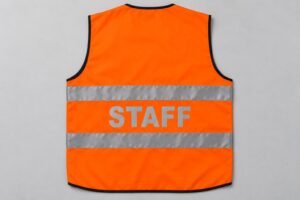
- Between the bands: the usual place for reflective lettering such as SECURITY.
- Never: on top of the retroreflective tape, or across the band gap so that the tape no longer gives 360° visibility.
Dark logo colours on a fluorescent panel also reduce contrast in a small area. That is fine for branding; just do not let the logo turn the vest into a mostly dark garment.
Logos added after purchase
A certified vest is certified as tested: fabric, tape, design and labelling. If a distributor or print shop later adds a large logo, the original manufacturer’s compliance claim may no longer describe the garment, and whoever decorated it takes on responsibility for the result. For certified custom hi vis vests it is safer to have the manufacturer apply the logo, check the remaining areas and label the vest correctly.
Compliance checklist for custom orders
- State the standard, type and class you need (for example ANSI/ISEA 107-2020 Type R Class 2, or EN ISO 20471 Class 2).
- Send your size range; the smallest size sets the logo limit.
- Keep logos off the reflective tape.
- Ask for a mockup with logo dimensions in mm or inches.
- Ask which test report or certificate covers the final design.
- Check the garment label: standard, class, size and care instructions.
More background on classes and colours is in our hi vis vest standards guide, and logo methods are compared in screen print vs heat transfer vs embroidery.
FAQ
Can I put my company logo on an ANSI vest?
Yes. ANSI/ISEA 107-2020 allows logos and lettering, provided the vest still meets the minimum visible background and retroreflective areas and the logo does not cover the reflective material.
How big can a logo be on a hi vis vest?
There is no single maximum size; it depends on how much spare fluorescent area the smallest vest has above the class minimum. Chest logos up to about palm size rarely cause problems; large back prints need checking.
Do reflective letters count toward the reflective area?
Do not rely on them. Compliance is designed around the vest’s retroreflective bands. Treat lettering as additional, and make sure it does not cover background area the vest needs.
Who is responsible if a logo breaks compliance?
Whoever makes the final compliance claim for the decorated garment. That is why it is safest for the manufacturer to apply and check the logo before the vest is labelled.
Sources and scope
Based on ANSI/ISEA 107-2020 and EN ISO 20471:2013+A1:2016 as applied in our production of custom hi vis vests. This is guidance for buyers, not legal advice; confirm requirements for your country and sector with your safety manager.