Short answer: for custom hi vis vests, screen printing is the best value for bold one- to three-colour logos on larger orders; heat transfer is best for detailed or full-colour logos, mesh vests and smaller runs; embroidery suits supervisor and corporate vests, ideally as a sewn patch; and reflective lettering is the choice when a word such as SECURITY or STAFF must be seen in headlights. The deciding factors are your artwork, the vest fabric and how the vests will be washed.
Every custom hi vis vest we make at Yolite starts with the same question from the buyer: “How will you put our logo on it?” The answer matters more than on a T-shirt. Hi-vis vests are made of fluorescent polyester that reacts badly to heat and to some inks, they are often washed at high temperature, and on a certified vest the logo must not cost you your compliance. Below is how the four methods behave on real vests.
The four logo methods compared
| Method | Best artwork | Best vest fabric | Set-up | Main risk on hi-vis |
|---|---|---|---|---|
| Screen printing | 1–3 flat colours, bold text | Solid polyester; mesh with large shapes | One screen per colour per position | Dye migration into light inks; ink on open mesh |
| Heat transfer | Fine detail, many colours, gradients | Mesh and solid polyester | Low | Too much heat scorches fluorescent fabric or tape |
| Embroidery | Simple logos, small text | Solid fabric, or as a patch | Digitising per logo | Puckering on light mesh; weight |
| Reflective lettering | Words, simple shapes | All | Cutting file | Placed over tape or too large for the class |
Screen printing on custom hi vis vests
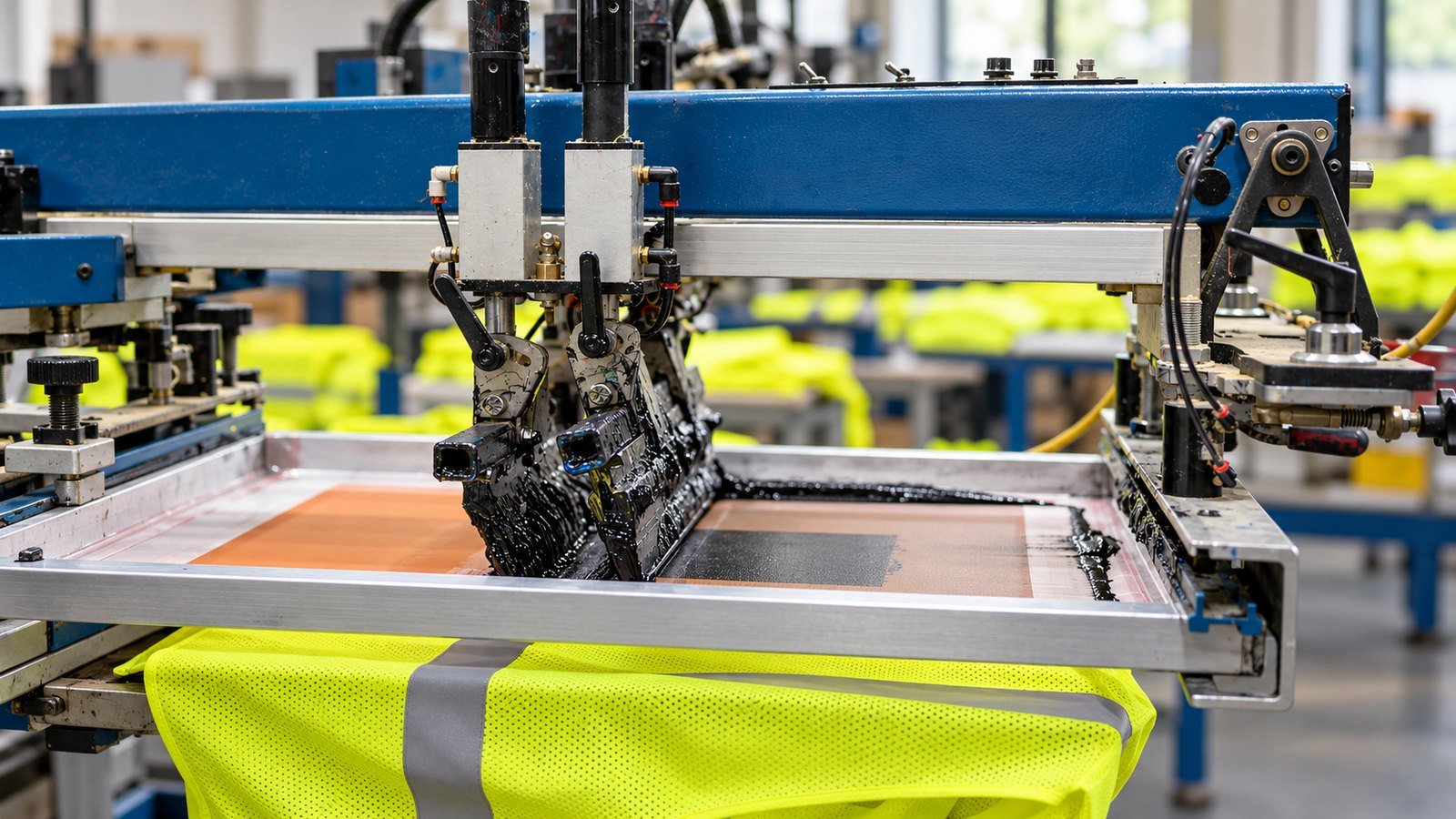
Screen printing pushes ink through a mesh stencil onto the vest, one screen per colour. Once the screens are made, each extra vest costs very little, which is why screen printing is the most common choice for large orders of custom hi vis vests with a simple logo.
Where it works
- Company names and logos in one to three solid colours.
- Large back prints on solid polyester vests.
- Orders where the same design runs on hundreds or thousands of vests.
What to watch on hi-vis fabric
Fluorescent polyester is coloured with disperse dyes that can migrate into ink when it is cured with heat. A white or pale ink can turn yellowish or orange over the fluorescent fabric. Factories avoid this with low-bleed (polyester) inks and a lower curing temperature. Ask your supplier which ink system they use on fluorescent fabric, and judge the colour on a physical sample rather than a digital proof.
On open mesh, ink can fall through the holes, and fine lines break up. For mesh vests keep screen-printed logos bold and simple, or use a heat transfer or a printed patch instead.
Heat transfer
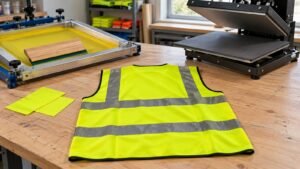
A heat transfer is a printed or cut film that is pressed onto the vest with heat and pressure. Because there is no screen per colour, it suits detailed and full-colour logos, small runs, and orders where every vest carries a different name or number.
- Best for: mesh vests, multi-colour logos, small and mixed orders.
- Watch: the transfer must be rated for polyester and for the wash temperature the vests will see; and the press temperature and time must be set low enough not to scorch the fluorescent fabric or damage the reflective tape nearby.
- Feel: large solid transfers make the panel stiffer and less breathable; on mesh vests, use a cut-out design rather than a solid block.
Embroidery
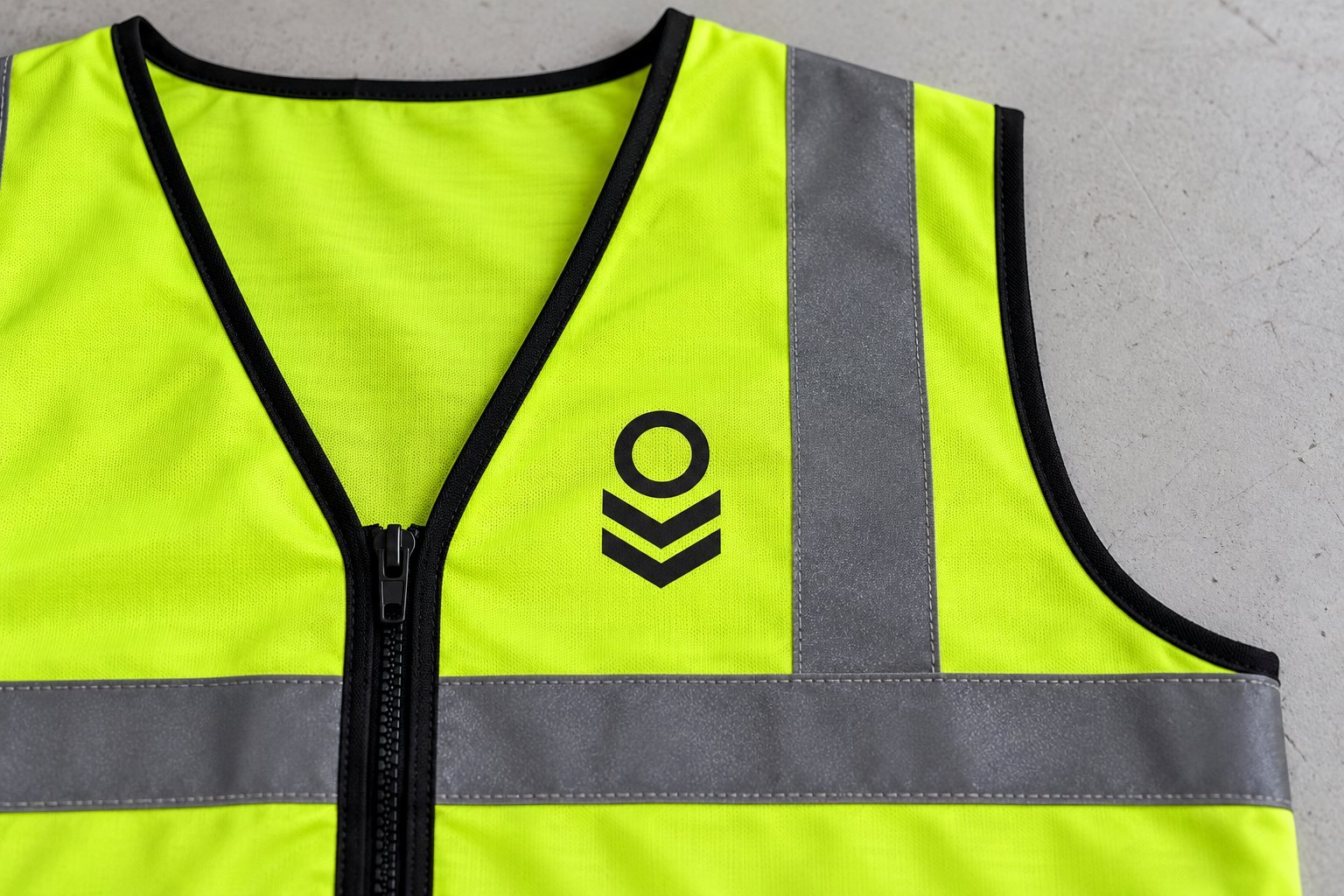
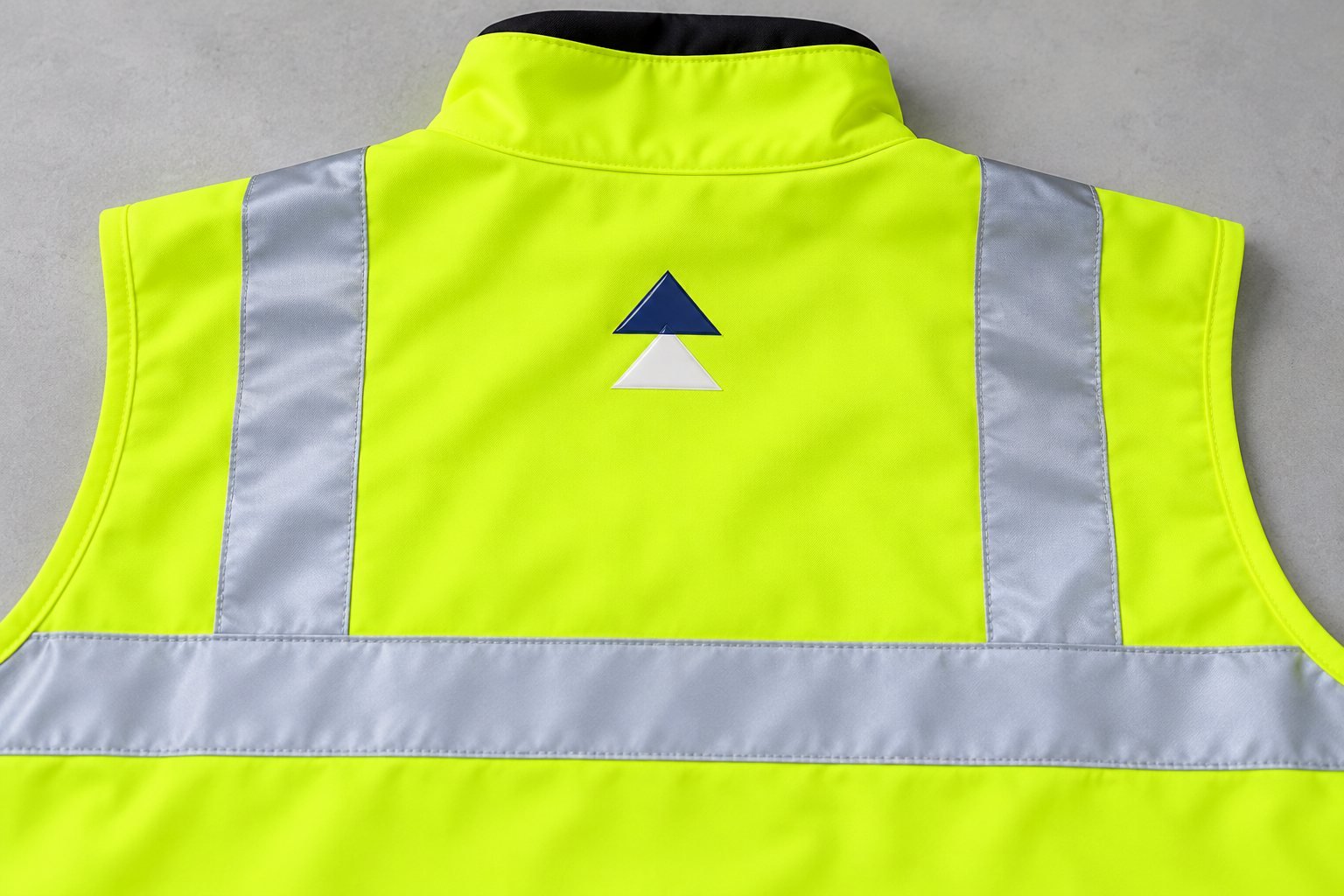
Embroidery stitches the logo in thread. It looks the most premium and lasts well, which is why it is popular on supervisor vests, surveyor vests and corporate uniform programmes. It is priced by stitch count, so a large back logo in embroidery is expensive and heavy.
On light polyester mesh, direct embroidery can pucker the fabric around the logo. The usual solution is an embroidered patch sewn onto the vest or onto a solid chest panel. A patch also lets you order the same logo for vests, jackets and caps.
Reflective lettering
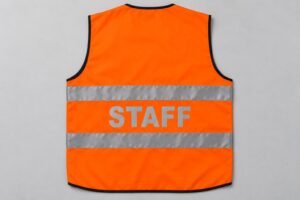
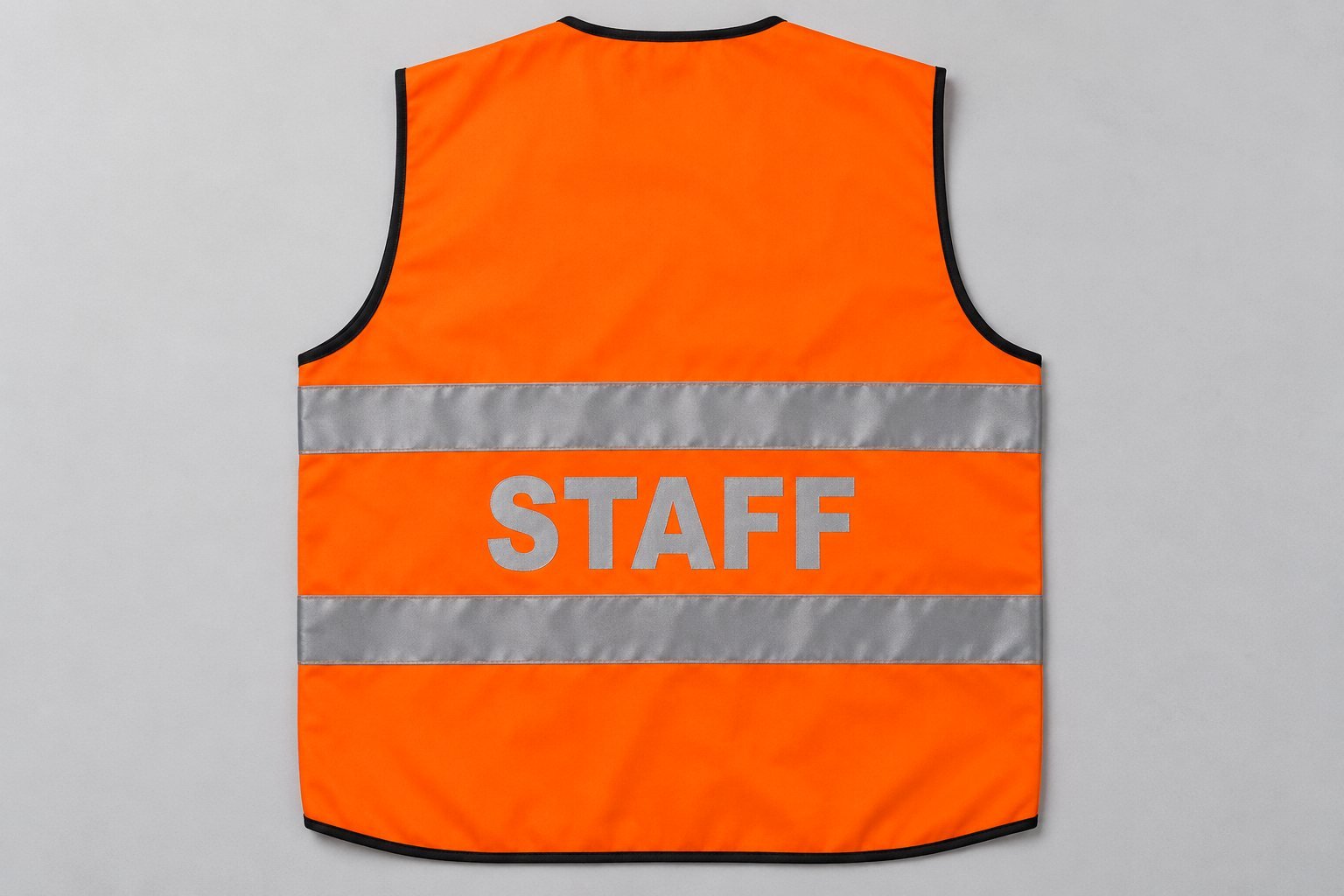
Reflective lettering is cut from retroreflective heat-transfer film. It is the right choice when a word has to be read at night, for example SECURITY, STEWARD, MEDIC or STAFF. It is normally placed between the two horizontal bands on the back, or above the upper band.
Two rules: lettering must not cover or replace the vest’s retroreflective bands, and on a certified vest the area it covers comes out of the fluorescent background, so very large lettering can push a small size below the class minimum. Our guide on logos and hi-vis compliance explains the calculation.
How to choose in 4 questions
- How many colours and how much detail is in your logo? Up to three flat colours: screen print. More colours or fine detail: heat transfer.
- Is the vest mesh or solid? Mesh: heat transfer or patch. Solid: any method.
- How many vests, and is the design the same on all of them? Large, identical runs favour screen printing; small or personalised runs favour heat transfer.
- Must the logo be seen at night? Add reflective lettering.
Many buyers combine methods: an embroidered chest patch for a smart look, plus a screen-printed or reflective back print for identification at a distance. When you send your logo with a quote request, we recommend a method and show it on a mockup before sampling. You can also see all decoration and build options on our customization page.
FAQ
Which logo method lasts longest on a hi vis vest?
Embroidery is usually the most durable, followed by properly cured screen printing and good-quality heat transfers. In practice the vest fabric and tape often wear out before a well-applied logo, so match the method to your artwork and washing rather than durability alone.
Can you print on the reflective tape?
No. Logos and lettering should never be applied on top of the retroreflective bands, because that reduces the reflective area the vest relies on at night and can break compliance.
What file should I send for a logo?
A vector file (AI, PDF, EPS or SVG) is best for screen printing and embroidery. A high-resolution PNG can work for heat transfer. Include Pantone colours if you have them.
Is screen printing cheaper than heat transfer?
On larger orders of the same design, usually yes, because the screen cost is spread across many vests. On small runs or many colours, heat transfer is often cheaper because there are no screens to make.
Sources and scope
Written by the Yolite production team from our experience decorating custom hi vis vests. Compliance notes refer to ANSI/ISEA 107-2020 and EN ISO 20471:2013+A1:2016. Ink and transfer behaviour depends on the specific product and fabric; always approve a physical sample.